We don't know what's coming next.
That may be the point.
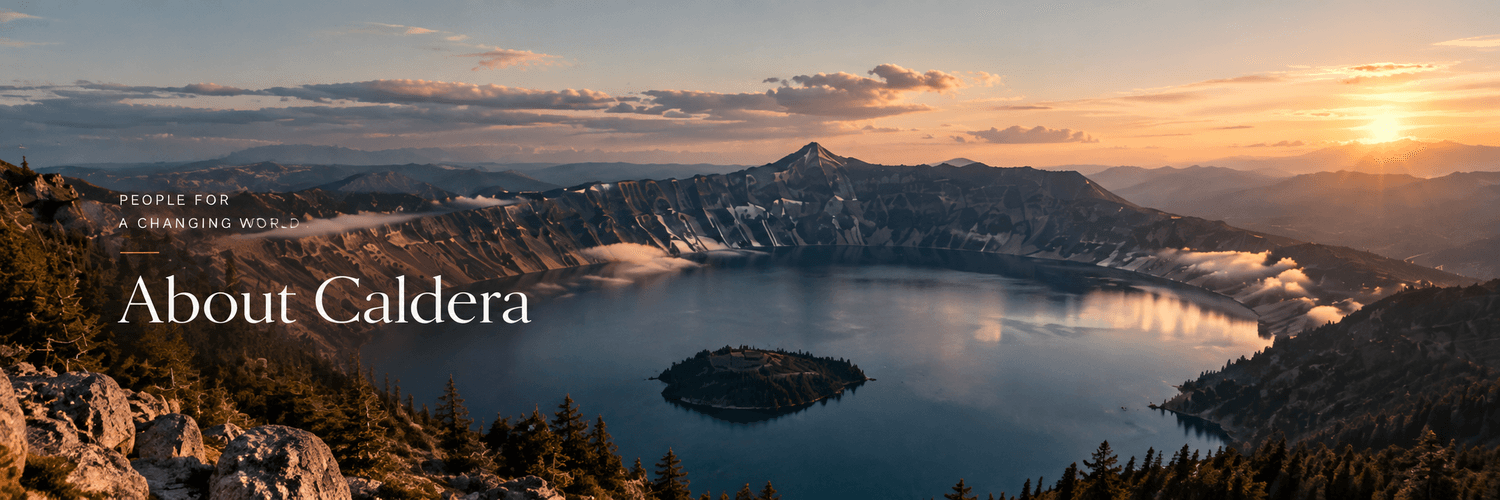
A caldera begins with pressure. Far beneath the surface, forces accumulate until the landscape can no longer remain as it was. The transformation can be violent, but the story does not end with the eruption. In the years that follow, the earth reorganizes itself. Water collects. New ecosystems take hold. What looks, at first, like an ending becomes the geography for something entirely new.
We liked that idea long before we liked it as a name.
Because change, for humans, works in much the same way. We tend to imagine adaptation as a return to equilibrium: something happens, we cope with it, and eventually we get back to normal. But the changes that matter most rarely allow us to go back. They alter the landscape. A job changes. An industry changes. A relationship changes. Technology changes where and how we create value. Life moves forward, and the person who was perfectly equipped for the world before may not be the person the new one requires.
Caldera was created to explore what happens next.
For much of modern working life, we have approached change by trying to anticipate it. We forecast which skills will matter, train people for new systems, reorganize companies around new technologies, and construct increasingly elaborate visions of the future. There is nothing wrong with preparing. The problem is that the future has a habit of arriving differently than expected.
Artificial intelligence has made this especially difficult to ignore. The technology is evolving faster than most organizations can redesign work around it, and faster still than we can confidently predict its long-term effects. A skill considered essential today may be automated tomorrow. A workflow redesigned this year may look antiquated two years from now. And eventually, even today's conversations about generative and agentic AI will give way to technologies and ways of working we do not yet have language for.
If we cannot reliably prepare people for everything that is coming, perhaps there is another way to prepare them.
What if, instead of trying to make people ready for every change, we helped them become better at change itself?
That question sits at the center of Caldera.
We see adaptability not as a corporate slogan or a fixed personality trait, but as a human capacity that can be developed. It shows up in what happens when certainty disappears: whether we become rigid or curious, whether we cling to familiar patterns or learn new ones, whether we can still think clearly under pressure, remain connected to other people, and move forward before every answer is available.
Today, AI gives us an unusually urgent place to put those capabilities to work. It is changing how we think, learn, create, decide, collaborate, and define valuable work, often all at once. But AI is not the destination of the work. It is the change in front of us now, and there will be others.
The ambition behind Caldera is to help build people and organizations that do not need the future to unfold exactly as predicted in order to be ready for it. People with enough internal stability to remain thoughtful under pressure, enough flexibility to revise what no longer works, and enough connection to remember that becoming more technologically capable should not require becoming less human.
That is where the name comes back into the story. A caldera is not the restoration of an old landscape. It is what forms when the old landscape has been irreversibly changed and life begins arranging itself around a new reality.
Perhaps human adaptability is much the same.
The aim is not to return unchanged. It is to become capable of what the new landscape requires.
THE CALDERA METHOD™
Human adaptability can be developed.
The Caldera Method builds the internal foundation people need to navigate change and perform through uncertainty.
Three interconnected capacities drive human adaptability:

Regulate
Stay grounded under pressure and uncertainty.

Rewire
Build new patterns, keep learning, and expand what's possible.

Relate
Strengthen connection, collaboration, and perspective.
These capacities prepare people for change itself.
HUMAN × AI applies them to the transformation happening now.