
Polyvagal Theory Made Simple: What It Means for Stress, Burnout, and Recovery
If you’ve ever wondered why you can feel completely safe in one situation and triggered in another — even when nothing “bad” is happening — you’ve felt the power of your nervous system at work.
The truth is, stress, burnout, and recovery aren’t just about mindset. They’re about how your body is wired to perceive the world. And one of the most powerful frameworks for understanding that wiring is Polyvagal Theory.
At Caldera, we like to strip away the jargon and bring the science into real life. So let’s make this simple: Polyvagal Theory explains why your body reacts the way it does under stress — and how you can train your system to return to safety, resilience, and energy.
The Nervous System: More Than Fight-or-Flight
For decades, most of us were taught that the autonomic nervous system had two gears:
Sympathetic (Fight-or-Flight): Mobilize and respond to threat.
Parasympathetic (Rest-and-Digest): Relax and recover.
That’s true — but incomplete.
Polyvagal Theory, pioneered by Dr. Stephen Porges, adds a critical missing piece: a third pathway that helps explain why we sometimes shut down, go numb, or “check out” under stress.
It’s called the Dorsal Vagal State — and it changes everything about how we understand stress, burnout, and recovery.
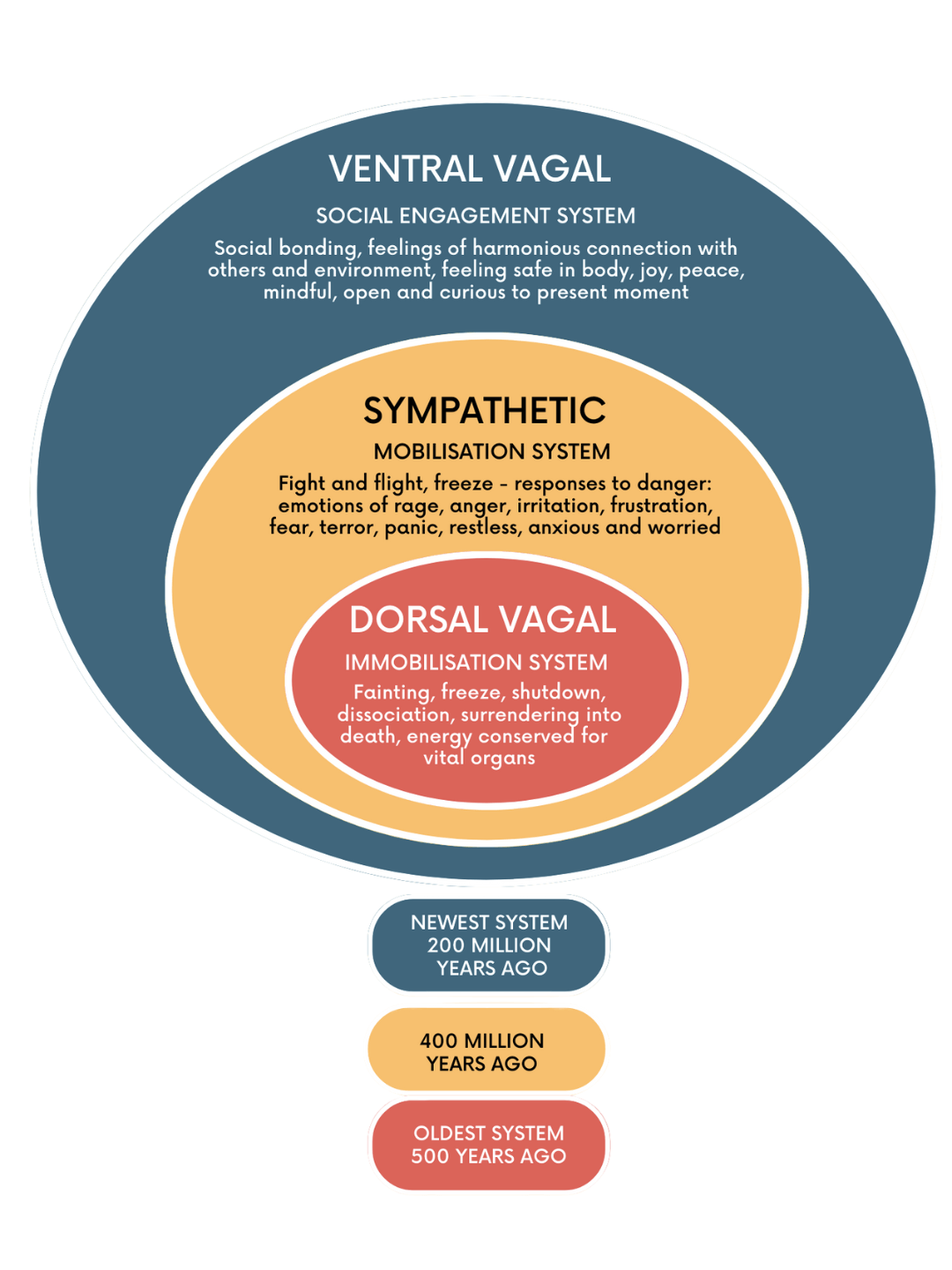
The Three States of Polyvagal Theory
Think of your nervous system like a ladder. Where you are on the ladder shapes how you feel, think, and act.
Ventral Vagal (Top of the Ladder): Connection & Safety
You feel safe, open, calm, engaged.
This is where creativity, learning, and healthy relationships happen.
Energy feels steady and sustainable.
Sympathetic (Middle of the Ladder): Mobilization
Your system detects a challenge or threat.
Adrenaline kicks in — heart races, muscles tense, focus narrows.
Helpful in short bursts, harmful if it becomes your baseline.
Dorsal Vagal (Bottom of the Ladder): Shutdown
When stress overwhelms, your system flips the breaker.
You may feel numb, disconnected, exhausted, or frozen.
Common in burnout, trauma, and chronic stress.
We climb up and down this ladder all day. Resilience isn’t about staying at the top — it’s about knowing how to move between the rungs without getting stuck.
Stress and Burnout Through the Polyvagal Lens
Think about a typical week.
On Monday morning, you might wake up in Ventral Vagal — calm, focused, ready to connect. You feel clear-headed, you joke with your partner, you’re in the flow.
Then the emails start pouring in. A client calls with a last-minute demand. You shift into Sympathetic — heart racing, shoulders tight, brain buzzing. You’re in problem-solving mode. For a while, it works. You get things done.
But if the stress doesn’t let up — if every day feels like firefighting — your body eventually says, enough. That’s when you drop into Dorsal Vagal shutdown. It feels like staring at your screen with zero motivation. Or lying in bed on Saturday with no energy to do the things you actually enjoy. It’s not laziness — it’s your nervous system hitting the brakes.
This is the cycle so many of us live in: sprint, crash, repeat. Burnout isn’t just “being tired.” It’s your system getting stuck at the bottom of the ladder.
Making the Ladder Practical
Here’s where Polyvagal Theory helps: once you know the ladder exists, you can start noticing where you are on it — and gently guide yourself back up.
In Sympathetic mode (fight-or-flight): Your body wants movement. Take a brisk walk, shake out your arms, dance to one song. You’re giving your system a way to use up the energy instead of holding it in.
In Dorsal shutdown: Your system needs cues of safety and connection. That could be calling a friend, cuddling your dog, or even stepping outside and feeling the sun on your face. Tiny signals tell your body, It’s okay, you can come back.
In Ventral safety: This is where you recharge. It’s when a conversation feels easy, or you lose track of time in creativity, or you finally exhale fully. The more time you spend here, the easier it becomes to find your way back after stress.

Why This Matters
When you understand the ladder, stress starts to make sense. Instead of beating yourself up for being “unmotivated” or “too anxious,” you realize: Oh, my nervous system is just on a different rung right now.
That awareness alone is powerful. Because once you see it, you can do something about it. You stop fighting yourself and start working with your biology.
And that’s the heart of resilience. It’s not about never getting stressed. It’s about being able to notice where you are, shift when you need to, and trust that you can always find your way back.
The Caldera Method™ Approach
Polyvagal Theory may sound scientific, but at its core, it’s about real life:
Why you snap at your kids after a long day, even when you don’t want to.
Why Netflix feels easier than starting that creative project when you’re burned out.
Why a walk with a friend can make you feel more alive than an entire weekend of “rest.”
Your nervous system isn’t working against you — it’s trying to protect you. When you learn the ladder, you gain the ability to guide yourself back to balance.
And that’s when resilience stops being a buzzword and becomes a lived experience: steady, grounded, and ready for whatever comes next.
This is exactly what we teach at The Caldera Method™: how to read the signals of your body, reset your system, and create rhythms that keep you from getting stuck at the bottom of the ladder.
Through our framework — Regulate, Rewire, Reimagine — high achievers learn that resilience isn’t just surviving stress. It’s building a nervous system that knows how to return to safety, energy, and clarity again and again.

Leila Quinn
Founder of The Caldera Method™, Leila Quinn is a former marketing executive turned healthcare advocate and certified wellbeing coach. A healthcare optimist, she believes we’re moving toward a future where resilience, wellbeing, and human potential take center stage in both personal lives and organizations.

The Caldera Method™ is a science-based framework that helps high achievers regulate their nervous system, build resilience, and achieve sustainable success without burnout.



The Caldera Method™ | All rights reserves | 2025